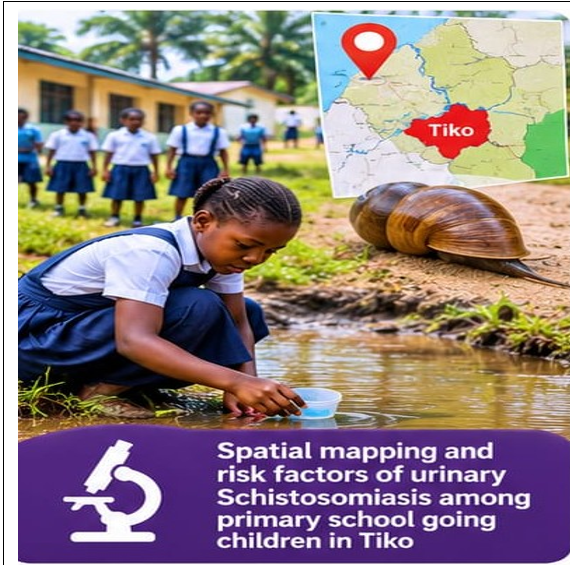
SPATIAL MAPPING AND RISK FACTOR ANALYSIS OF URINARY SCHISTOSOMIASIS TRANSMISSION IN SCHOOL AGED CHILDREN IN TIKO SUB DIVISION
Abstract
Introduction: Urinary schistosomiasis caused by Schistosoma haematobium remains a Public Health concern among school-aged children in endemic communities of Cameroon. Tiko Sub-Division has documented transmission, but detailed local spatial mapping and risk-factor information is limited. Objective: The main aim of this study was to determine the prevalence, spatial distribution, and risk factors associated with urinary schistosomiasis among school-aged children in Tiko Sub-Division. Methods: A school-based cross-sectional study was conducted from November 2025 to July 2026 among 396 children aged 6–16 years recruited from seven health areas. Data were collected using a structured questionnaire and urine laboratory analysis for S. haematobium eggs. School GPS coordinates were recorded and analyzed using a geographic information system. Data was analyzed using IBM SPSS version 25.0. Chi square statistical test or Fisher’s Exact test were used to assessed associations in the bivariate analysis. Logistic regression was performed for all variables with P values ≤ 0.25 in the bivariate analysis. Statistical significance was set at P value <0.05. Results: The mean age of study participants was 11.62 ± 1.72 years and male gender predominated the study population. Urinary schistosomiasis prevalence was 7.8% (31/396; 95% CI: 5.16–10.44%). Prevalence ranged from 14.3% in Kange health area to 0.0% in Mudeka health area. No socio-demographic, hygienic, or environmental variable was significantly associated with infection at bivariate analysis (p > 0.05). Freshwater visitation was the only independent predictor with children who visited freshwater bodies having higher odds of infection (aOR = 3.24; 95% CI: 1.06–9.76; p = 0.037). Conclusion: Urinary schistosomiasis remains actively transmitted among school-aged children in Tiko Sub-Division, with marked spatial heterogeneity. Freshwater visitation was independently associated with infection. Spatially targeted surveillance, health education, access to safe water and sanitation, and sustained preventive treatment are warranted in affected areas.
Keywords
Cite this article
APA
Kome Terence Nnorge, Nyingchu Robert Vuchuh, Rene Ning Teh (2026). SPATIAL MAPPING AND RISK FACTOR ANALYSIS OF URINARY SCHISTOSOMIASIS TRANSMISSION IN SCHOOL AGED CHILDREN IN TIKO SUB DIVISION . Maflekumen Community Health and Research Journal, 1(2). https://maflekumenjournals.com/community-health-and-research/article/spatial-mapping-and-risk-factor-analysis-of-urinary-schistosomiasis-transmission-in-school-aged-children-in-tiko-sub-division
BibTeX
@article{nnorge2026spatial,
  title   = {SPATIAL MAPPING AND RISK FACTOR ANALYSIS OF URINARY SCHISTOSOMIASIS TRANSMISSION IN SCHOOL AGED CHILDREN IN TIKO SUB DIVISION },
  author  = {Kome Terence Nnorge and Nyingchu Robert Vuchuh and Rene Ning Teh},
  journal = {Maflekumen Community Health and Research Journal},
  year    = {2026},
  volume  = {1},
  number  = {2},
  url     = {https://maflekumenjournals.com/community-health-and-research/article/spatial-mapping-and-risk-factor-analysis-of-urinary-schistosomiasis-transmission-in-school-aged-children-in-tiko-sub-division}
}